
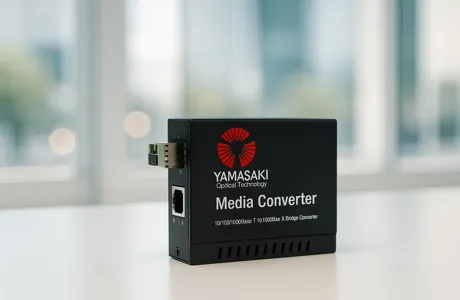
SFP Media Converter – Flexible Fibre Connections
Why an SFP Media Converter is Essential
In today’s modular fibre networks, the need for flexibility is more critical than ever. A SFP Media Converter offers that flexibility by allowing businesses to scale, adapt, and connect fibre and Ethernet segments without being locked into one specific interface or connector type.
Because SFP-based converters use removable transceivers, they support both single-mode and multimode fibre, as well as different wavelengths and connector types. This means one device can serve multiple roles across campus networks, enterprise backbones, or telecom uplinks.
Furthermore, network teams can quickly adapt to changing requirements. Whether you’re upgrading from 1G to 10G, changing fibre types, or extending your network between locations, an SFP Media Converter provides a cost-effective and space-saving solution.
To understand how media converters fit into the broader network ecosystem, read our foundational guide:
Media Converters – Bridging Network Gaps
What Is an SFP Media Converter?
An SFP Media Converter is a modular network device that bridges fibre and copper connections using a small form-factor pluggable (SFP) transceiver. It allows you to connect Ethernet devices to fibre networks in a scalable and adaptable way.
Unlike fixed fibre converters, SFP models accept different SFP modules. This means you can change speed, fibre type, or wavelength simply by swapping the transceiver—without replacing the entire converter.
Key Features of an SFP Media Converter:
- Accepts both single-mode and multimode SFP modules
- Supports 1G and 10G data rates, depending on the SFP
- Offers hot-swappable transceiver slots for easy upgrades
- Enables long-distance fibre transmission across copper networks
- Works in standalone setups or chassis-based systems
- Often includes link fault pass-through for troubleshooting
Because of its modular design, the SFP converter fits well in environments where flexibility and future-proofing are priorities.
To learn more about fibre converter fundamentals, see:
How Do Fibre Media Converters Work?
Benefits of Using an SFP Media Converter
An SFP Media Converter is more than just a connector between fibre and Ethernet. It provides a highly flexible, modular solution that adapts as your network evolves. Whether you’re upgrading existing infrastructure or planning a new fibre deployment, this device delivers both performance and cost efficiency.
1. Interchangeable SFP Modules Offer Flexibility
With SFP support, you can swap modules to match specific fibre requirements. For instance, you might start with multimode fibre for short-range needs and later switch to single-mode for long distances. Because of this flexibility, one device can serve multiple deployment scenarios.
2. Simplifies Upgrades Without Replacing Hardware
Instead of replacing an entire converter when your fibre type or speed changes, you can simply install a different SFP transceiver. This plug-and-play model reduces waste and saves time during network upgrades.
Furthermore, it means you can standardise on one converter chassis and customise fibre connectivity as needed.
3. Supports Long-Distance Transmission
Depending on the SFP module you choose, these converters can support transmission distances ranging from a few hundred metres up to 80 kilometres. As a result, they are ideal for inter-building links, multi-campus networks, and remote site connectivity.
4. Ideal for Dynamic and Mixed Environments
Because fibre requirements often differ across sites or departments, flexibility is crucial. An SFP Media Converter allows IT teams to deploy a single hardware platform while adapting modules for different wavelengths, connector types, or transmission ranges.
In addition, it allows seamless transitions from copper to fibre without major infrastructure changes.
5. Reduces Operational Downtime
Most converters support hot-swappable SFP modules, which means you can change or upgrade connections without powering down the unit. This is particularly useful in critical environments where uptime is essential.
If you’re currently running a fixed-fibre solution, learn how SFP flexibility compares here:
Standalone vs Chassis Media Converters – Which Is Right for You?
Fixed Fibre vs SFP Media Converters
When selecting a media converter, it’s important to understand the key differences between fixed fibre models and SFP Media Converters. While both serve similar purposes, they offer vastly different levels of flexibility, scalability, and long-term value.
The table below outlines how each type compares across essential features.
Comparison Table
| Feature | Fixed Fibre Converter | SFP Media Converter |
|---|---|---|
| Fibre Compatibility | Locked to one fibre type | Compatible with multiple SFP modules |
| Upgrade Path | Requires replacing entire unit | Swap out the SFP to upgrade or adapt |
| Deployment Flexibility | Limited to specific scenarios | Works in a wide range of applications |
| Cost Over Time | Higher due to frequent replacements | Lower with modular upgrades |
| Best Use Case | Static, single-mode deployments | Dynamic, evolving networks |
Which One Should You Choose?
If your network needs are predictable and unlikely to change, a fixed-fibre model might be enough. However, if you plan to scale, change fibre types, or mix distances within the same environment, an SFP Media Converter offers a much more adaptable solution.
Moreover, many businesses prefer SFP models because they reduce inventory complexity. You can keep one base unit and stock different SFPs to meet a variety of network conditions.
For help comparing installation styles and form factors, read:
Standalone vs Chassis Media Converters – Which Is Right for You?
How to Use an SFP Media Converter
Setting up an SFP Media Converter is quick and straightforward. Thanks to its modular design, you can install it in various environments with minimal configuration. Whether you’re deploying it in a rack-mounted chassis or as a standalone unit, the process remains simple.
Follow these steps to get started:
Step-by-Step Installation Guide
- Select the Correct SFP Module
First, determine the type of fibre you’re using—single-mode or multimode—and the distance required. Choose a compatible SFP transceiver that supports your network specifications. - Insert the SFP into the Converter
Carefully align and insert the SFP module into the SFP slot of the media converter. Make sure it clicks into place and sits flush with the unit. - Connect the Fibre Cable
Attach your LC or SC fibre cable to the SFP module. Always clean connectors before plugging them in to avoid signal loss. - Connect the Copper Interface
Plug a Cat6 or Cat6a Ethernet cable into the RJ-45 port of the converter. This connects your fibre uplink to a switch, server, or router. - Power On and Test
Finally, apply power and verify link/activity LEDs. If using a managed converter, you may also access a web UI or SNMP dashboard to review diagnostics.
Because SFP converters are plug-and-play by default, most setups require no advanced configuration. However, managed models may include options like VLAN tagging or link fault pass-through.
For tips on choosing between managed and unmanaged units, check out:
Managed vs Unmanaged Media Converters – What’s the Difference?
Applications Across Industries
The SFP Media Converter is highly adaptable, making it suitable for a wide range of industry applications. Because it supports interchangeable fibre modules, it provides unmatched flexibility across environments where conditions, distances, and device types vary.
Let’s explore where and why businesses rely on SFP-based converters:
Enterprise & Campus Networks
Large organisations with multiple buildings often need to link distant LAN segments. Using SFP converters, IT teams can standardise on one platform while tailoring fibre modules by distance and fibre type. As a result, network upgrades and maintenance become far more efficient.
Government, Education & Health Sectors
Public institutions often operate within strict budget and infrastructure limits. Fortunately, SFP media converters enable long-range, high-speed fibre connectivity using existing copper switches, saving both money and downtime. They’re also perfect for mixed-fibre environments, such as university campuses and hospital complexes.
Cloud Hosting & Data Centres
High-performance networks demand speed, reliability, and modular design. Because of their hot-swappable SFP slots, these converters allow quick changes to accommodate bandwidth demands, including 10G SFP+ modules.
To understand how they fit into high-speed environments, see:
10G Media Converter – High-Speed Networking Simplified
Industrial & Harsh Environments
When used with ruggedised chassis and industrial-rated SFPs, these converters can perform in dusty, vibrational, or temperature-sensitive settings. As a result, manufacturers and logistics centres often deploy them across warehouse automation systems and factory floors.
For outdoor or rugged use, see:
Industrial Media Converter – Built for Harsh Environments
PoE-Enabled Applications
When combined with PoE media converters, SFP models help power and connect IP cameras, VoIP phones, or wireless access points—all via long fibre runs. This eliminates the need for separate power sources.
Learn more about powering devices via fibre here:
PoE Media Converter – Power and Data Over One Cable
Standards & Product Recommendations
Before selecting an SFP Media Converter, it’s important to confirm the device meets local compliance requirements. In Australia, equipment used in fixed network installations must conform to standards that ensure safety, interoperability, and electromagnetic compatibility.
Fortunately, several trusted models—including the one we recommend below—adhere to these specifications while delivering high performance and modular flexibility.
Australian Standards to Know
- AS/CA S008:2020 – Requirements for Cabling Products
This standard ensures media converters and their supporting components are safe, structurally sound, and fit for use in permanent telecom installations. - EMC and RCM Compliance
All SFP media converters sold in Australia must display the RCM mark, proving they’ve been tested for electromagnetic compatibility (EMC) and meet ACMA regulatory conditions.
Because these standards are mandatory for most business and enterprise deployments, it’s essential to verify your media converter meets them before installation.
Recommended Product: C400 Series SFP Media Converter
If you need a reliable, standards-compliant solution, we recommend the
Anderson C400 Series SFP Media Converter
This unit offers:
- One SFP slot (1G or 10G compatible)
- One RJ-45 Ethernet port (Gigabit copper)
- Single-mode or multimode support via modular SFPs
- DIN rail or wall-mounting options
- Hot-swappable transceiver compatibility
- RCM-marked and fully AS/CA S008 compliant
For technical specifications or to view compatibility modules, visit the product page directly.
Manufacturer-Backed Alternative
Additionally, you can view the manufacturer’s model here:
Yamasaki RJ45–SFP Multimode/Singlemode Media Converter
This model delivers excellent fibre adaptability with plug-and-play simplicity, perfect for flexible fibre rollouts.
Frequently Asked Questions About SFP Media Converters
1. What is an SFP Media Converter used for?
An SFP Media Converter connects Ethernet devices to fibre networks using modular SFP transceivers. As a result, it allows flexible deployment across various fibre types and speeds. It’s commonly used in enterprise, campus, and data centre networks.
2. Can I use any SFP module with an SFP media converter?
Not always. While most converters support a wide range of SFPs, it’s important to match your module’s speed (1G or 10G) and fibre type (single-mode or multimode). Additionally, check for compatibility between the converter and the module’s manufacturer.
3. What’s the difference between SFP and SFP+ converters?
SFP supports up to 1 Gbps, while SFP+ handles 10 Gbps. SFP+ converters are ideal for high-speed applications like data centres or cloud infrastructure. However, both share the same physical form factor, which adds to their flexibility.
To learn more about 10G fibre, see:
10G Media Converter – High-Speed Networking Simplified
4. Do I need a managed or unmanaged version?
It depends. If you require remote diagnostics, VLAN tagging, or link fault pass-through, go with a managed SFP media converter. For simpler links, an unmanaged model will be easier and more cost-effective to deploy.
5. Is an SFP Media Converter better than a fixed fibre converter?
Often, yes—especially if your network needs are dynamic. Because SFP converters allow you to change fibre types and speeds without replacing the hardware, they provide better long-term value and minimise downtime during upgrades.
Why an SFP Media Converter Is the Smarter Choice for Scalable Networks
As fibre networks continue to evolve, choosing the right media converter can make all the difference. The SFP Media Converter is a standout choice for organisations that value scalability, flexibility, and long-term return on investment. Its modular design enables seamless upgrades without ripping and replacing hardware—saving both time and money.
Because it supports swappable SFP modules, it adapts to changes in fibre type, speed, and deployment distance. Whether you’re managing a campus network, connecting remote offices, or preparing for higher bandwidth, an SFP solution grows with you.
Furthermore, when you choose an SFP media converter that complies with Australian Standards like AS/CA S008 and carries RCM marking, you ensure both legal compliance and network reliability.
Ready to Upgrade Your Fibre Infrastructure?
Choose a trusted, standards-compliant solution:
🔗 C400 Series SFP Media Converter – Anderson Corporation
Or view the product on the manufacturer’s site:
🔗 Yamasaki RJ45-SFP Multimode/Singlemode Media Converter
And for a broader view of how media converters streamline fibre expansion, explore:
Media Converters – Bridging Network Gaps
For more information you can contact us here.