
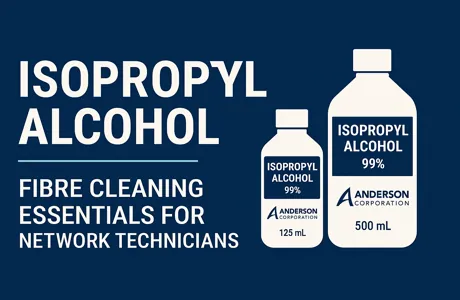
Fibre Cleaning Alcohol – A Fibre Cleaning Essential
When it comes to keeping fibre networks clean, reliable, and compliant, Fibre Cleaning Alcohol is the trusted industry standard. This high-purity solvent is essential for removing microscopic dust, oil, and residue from fibre optic connectors — contaminants that would otherwise cause increased insertion loss, return loss, and long-term signal degradation.
Used properly, Isopropyl Alcohol helps ensure every connection meets strict optical performance standards. Whether you’re installing, testing, or maintaining a network, having 99% IPA in your toolkit is non-negotiable.
In this guide, we’ll explore how Isopropyl Alcohol fits into professional fibre optic cleaning methods, what tools you’ll need, and how to avoid common cleaning mistakes. You’ll also discover how to apply it safely and effectively, both in the lab and the field.
For a broader overview of fibre cleaning tools, techniques, and methods, read our Fibre Optic Cleaning – Tools, Tips & Best Practices post.
Why Fibre Cleaning Alcohol is Used
Fibre Cleaning Alcohol plays a critical role in fibre optic cleaning due to its ability to dissolve oils, remove debris, and evaporate quickly without leaving residue. However, not all IPA solutions are created equal. For fibre networks, only 99% fibre cleaning Alcohol is suitable.
What Is 99% IPA — and Why Does Purity Matter?
99% Fibre Cleaning Alcohol (IPA) refers to a highly concentrated form of the solvent, containing just 1% water. This high purity is essential in fibre applications for several reasons:
- It evaporates quickly, reducing the risk of moisture contamination.
- It leaves no conductive or corrosive residues behind.
- It dissolves oils and particulate matter effectively, allowing for reliable cleaning of ferrule end faces.
Lower purity alcohols, such as 70% IPA, often contain a significant amount of water. This water can:
- Leave residue on the connector surface
- Increase drying time, which attracts airborne dust
- Introduce micro-corrosion inside the ferrule or port
Medical-Grade vs. Fibre-Grade IPA
Many technicians assume that medical-grade IPA is suitable for fibre work. In reality, there’s a major difference:
| Type | Purity | Additives | Fibre-Safe? |
|---|---|---|---|
| Medical-grade IPA | 70–91% | Often includes moisturisers or fragrance | ❌ No |
| Fibre-grade IPA | 99% | No additives | ✅ Yes |
Fibre-grade IPA is filtered and packaged specifically for use on sensitive optical components. It is the only acceptable form of Isopropyl Alcohol for fibre optic cleaning applications.
How IPA Affects Insertion Loss and Return Loss
Contaminants on the connector end face — even microscopic ones — can interfere with signal transmission. If not properly removed, these particles can:
- Increase insertion loss by disrupting the optical path
- Cause return loss by reflecting light back into the source, especially in single-mode applications
- Lead to intermittent connection issues and long-term performance degradation
Using 99% Isopropyl Alcohol helps ensure these contaminants are completely removed, restoring the ferrule surface to its proper condition before connector mating or testing.
Why IPA is a Fibre Cleaning Staple
Incorporating Isopropyl Alcohol into your cleaning routine significantly improves connection reliability and network uptime. Combined with the correct technique and materials — such as lint-free wipes or cleaning swabs — IPA delivers results that meet or exceed international inspection standards.
For a complete overview of contamination issues and how to address them, visit our Fibre Optic Cleaning – Tools, Tips & Best Practices guide.
Fibre Optic Cleaning Tools Required
Cleaning fibre connectors correctly isn’t just about using Isopropyl Alcohol — it’s about using the right combination of tools and consumables to ensure contaminants are effectively removed without damaging the connector end face. Below is a breakdown of the essential fibre optic cleaning tools every technician should carry when working with Isopropyl Alcohol in the field or in the lab.
99% Fibre Cleaning Alcohol (Fibre-Grade)
This is the cornerstone of fibre cleaning. Only 99% fibre-grade Alcohol should be used. Lower-grade solutions (e.g., 70% IPA) contain water and additives that can leave residue and damage sensitive optical components.
- Application: Apply a small amount of IPA to a clean, lint-free wipe or swab.
- Storage: Always store IPA in a sealed, fibre-safe dispenser to avoid contamination or evaporation.
- Tip: Never pour IPA directly onto the connector or use from an open container.
For more information on the role of IPA in fibre cleaning, see our full Fibre Optic Cleaning Tools, Tips & Best Practices guide.
Lint-Free Wipes and Swabs
Lint-free wipes, such as Kim Wipes or other fibre-grade options, are essential for wet-to-dry cleaning methods. They remove particles without shedding fibres or introducing new contamination.
Swabs (also called cleaning sticks) are designed to clean hard-to-reach areas, such as inside adapter ports or bulkhead-mounted connectors.
- Use wipes for exposed connector end faces.
- Use swabs with IPA for in-port or recessed cleaning.
Always dispose of wipes and swabs after a single use to prevent cross-contamination.
Pre-Saturated Wipes (Fibre-Safe)
For technicians working in the field, pre-saturated wipes offer a portable and consistent alternative to bottled IPA. These single-use wipes are impregnated with fibre-grade 99% Isopropyl Alcohol and individually sealed to maintain purity.
- Advantages:
- No measuring or dispensing required
- Ideal for mobile teams or multi-site work
- Reduces risk of overapplication or spill hazards
These wipes are particularly helpful when working in environments where carrying liquid is restricted or inconvenient.
Fibre Inspection Scopes
No cleaning process is complete without verification. A fibre inspection scope allows you to visually confirm that the connector is free of debris, residue, or damage — before and after cleaning.
Modern scopes provide:
- High magnification to detect microscopic contamination
- Digital pass/fail grading in compliance with IEC 61300-3-35
- Support for both male and female connectors
Skipping the inspection step is one of the most common cleaning mistakes. Proper cleaning must be validated.
Recommended Field Kit Setup
Your cleaning toolkit should include:
- Bottle or dispenser of 99% IPA
- Lint-free wipes in a sealed container
- Fibre-grade cleaning sticks/swabs
- Pre-saturated wipes (optional for portability)
- Inspection scope with auto-analysis
For a full list of recommended tools, see the Fibre Optic Cleaning Tools section in our main guide.
How to Use Fibre Cleaning Alcohol on Fibre Optics
Knowing how to use Fibre Cleaning Isopropyl Alcohol on fibre is essential for achieving clean, low-loss connections in any optical network. Whether you’re working in a data centre, the field, or a lab environment, using 99% IPA with the correct cleaning method can significantly reduce signal loss and eliminate harmful contamination.
How to Clean Fibre Connectors with Fibre Cleaning Alcohol
To clean fibre connectors with Isopropyl Alcohol, apply 99% IPA to a lint-free wipe. Wipe the connector ferrule in one straight motion across the damp area, then immediately dry it using a clean, dry section of the wipe. This wet-to-dry method effectively removes dust, oil, and polishing residue from the connector end face.
Step-by-Step: How to Use Fibre Cleaning Alcohol
Use this process when cleaning SC, LC, ST, or other single-fibre connectors:
- Inspect the Connector
Use a fibre inspection scope to check for dust, oils, or smudges before cleaning. - Prepare a Clean Wipe
Fold a lint-free wipe into a flat surface large enough to drag the connector tip across. - Apply 99% Isopropyl Alcohol
Moisten one corner or section of the wipe with a few drops of IPA. Do not oversaturate. - Clean the Ferrule (Wet Stroke)
Gently draw the connector end face across the damp section in a straight line. Apply light, even pressure. - Dry the Connector (Dry Stroke)
Immediately drag the connector across the dry part of the wipe to remove any remaining residue. - Re-Inspect the Connector
Use the scope again to verify that the end face is clean, clear, and compliant.
Where IPA Fits in the Wet-to-Dry Cleaning Method
The wet-to-dry method is the most effective manual cleaning technique used by fibre technicians worldwide. The Isopropyl Alcohol dissolves oils and lifts particles from the ferrule surface. Following with a dry wipe prevents streaking, recontamination, or moisture retention.
- Wet stroke = cleaning
- Dry stroke = residue removal and fast evaporation
This method ensures that no IPA remains on the connector, which is critical in environments where moisture or electrostatic attraction can affect signal transmission.
Field Use vs Lab Use of Isopropyl Alcohol
In the lab environment, technicians typically work with controlled dispensers, dedicated drying stations, and scope-integrated benches. This setup allows for precise application of Isopropyl Alcohol, delivering consistent results with minimal waste. By contrast, field environments demand portability and adaptability. Technicians on-site often rely on pre-saturated IPA wipes, compact dispensers, or sealed alcohol pens to maintain cleaning standards without bulky equipment.
Technicians typically use:
- Pre-saturated IPA wipes for convenience
- Sealed IPA pens or controlled-dispensing bottles
- Minimal gear that still meets inspection standards
Both environments require the same cleaning discipline — inspect, clean, re-inspect — but the tools may differ based on mobility and access.
Avoid Passive Cleaning Errors
Always control the cleaning action. Never assume a wipe or pre-saturated cloth will “do the job on contact.” Guide the cleaning process with deliberate, smooth strokes, and visually verify the results. This hands-on approach ensures every connector meets IEC 61300-3-35 standards for cleanliness and optical performance.
Isopropyl Alcohol vs One-Click Cleaners – Which is Better?
When it comes to fibre optic cleaning, technicians often ask: should I use Isopropyl Alcohol (IPA) with lint-free wipes, or opt for a One-Click Cleaner? The answer depends on the connector type, work environment, and the technician’s preference — but each method offers clear strengths in specific scenarios.
Manual Wet-to-Dry Cleaning (IPA Method)
The wet-to-dry method uses 99% Isopropyl Alcohol and lint-free wipes to physically remove oils, dust, and polishing residues from the connector end face. It’s a tried-and-tested technique that provides full visibility and control over the cleaning process.
Advantages:
- Highly effective on greasy or adhesive-based contamination
- Compatible with all connector types (SC, LC, ST, MPO, etc.)
- Cost-effective, especially for large-scale cleaning
- Allows technicians to adjust pressure and motion for precise cleaning
Limitations:
- Requires careful handling of IPA and wipes
- Prone to inconsistency if not performed correctly
- Less convenient in high-density or confined spaces
- Slower for repetitive cleaning tasks
Mechanical Dry Cleaning (One-Click Cleaners)
One-Click Cleaners are mechanical tools that use a spring-loaded cleaning fabric to remove dust and debris from the connector ferrule. With a simple push, the cleaner rotates and wipes the end face without the use of liquid solvents.
Advantages:
- Extremely fast and easy to use
- No alcohol or wet materials required
- Delivers consistent, repeatable cleaning
- Perfect for tight racks and field installations
Limitations:
- May not fully remove oily or sticky residue
- Limited number of cleaning cycles per tool (typically 500+)
- Not suitable for bare fibre cleaning
Connector-Specific Suitability
| Connector Type | IPA Method | One-Click Cleaner | Recommended Approach |
|---|---|---|---|
| SC/LC | Yes | Yes | Either method – One-Click for speed, IPA for deeper clean |
| MPO/MTP | Yes* | Yes | One-Click preferred (specifically MPO/MTP cleaners) |
| Bare Fibre | Yes | No | IPA method required |
| Bulkhead Ports | Yes (with swabs) | Yes (with adapter tip) | One-Click is faster but swabs with IPA are more thorough |
*IPA method for MPO requires precision and parallel ferrule coverage, making it less practical in fast-paced environments.
Which Method Should You Choose?
If you’re cleaning fibre jumpers in a lab or preparing for a fusion splice, the wet-to-dry method using Isopropyl Alcohol provides deeper, controlled cleaning — especially where contamination is visibly stubborn or greasy.
In contrast, for high-volume patch panels, quick test setups, or routine field work, a One-Click Cleaner saves time and simplifies the process. It also ensures repeatability without the risk of over-wetting or improper wipe technique.
For a full breakdown of fibre cleaning options, visit our Fibre Optic Cleaning Methods Comparison guide.
Safety Guidelines for Isopropyl Alcohol Use
While Isopropyl Alcohol is a highly effective fibre cleaning solvent, it must be used with care to ensure the safety of both technicians and fibre components. From correct handling to responsible disposal, every step in the cleaning process should follow established safety protocols — particularly when working in confined, high-density, or customer-facing environments.
Handling and Storage Tips
99% Isopropyl Alcohol is a flammable liquid and should always be stored and handled appropriately to reduce the risk of fire or exposure.
Best practices for safe handling include:
- Always use IPA in a well-ventilated area to avoid fume accumulation.
- Keep IPA bottles sealed when not in use to prevent evaporation or contamination.
- Use fibre-safe dispensers or dropper bottles that allow precise application without spills.
- Store IPA away from heat sources, electrical equipment, or open flames.
- Clearly label all containers with hazard information and usage instructions.
Avoid decanting IPA into unmarked or non-fibre-grade containers, as this introduces risk of misuse or contamination.
Fibre Safety Guidelines and PPE
Technicians must not only protect themselves but also the integrity of the fibre network when using Isopropyl Alcohol.
Personal protective equipment (PPE) recommendations include:
- Nitrile gloves to prevent skin irritation and eliminate fingerprint contamination
- Safety glasses when working with bulk IPA or in overhead positions
- Anti-static work surfaces or mats to avoid attracting debris
Also:
- Never allow IPA to contact bare fibre prior to splicing without full evaporation
- Clean up spills immediately to avoid slippery surfaces or evaporated fumes
Following a structured Isopropyl Alcohol fibre safety guide ensures technicians maintain both personal safety and fibre network integrity — particularly in controlled environments such as data centres, labs, and fusion splice stations.
Safe Disposal Practices
Used wipes, swabs, or containers that have come into contact with IPA must be disposed of properly. IPA is considered hazardous waste under Australian workplace safety regulations.
Disposal guidelines:
- Place used cleaning materials in a sealed, fibre-safe disposal bag or container
- Do not discard IPA-saturated wipes with general rubbish
- Follow your site’s hazardous waste disposal policy or consult with a local waste management authority
Larger volumes of expired or contaminated IPA should be treated as regulated waste and removed through licensed chemical disposal services.
Taking these precautions ensures that Isopropyl Alcohol continues to be an efficient, fibre-safe cleaning solution — without introducing safety hazards or compromising environmental responsibility.
Common Mistakes When Cleaning with Isopropyl Alcohol
While Isopropyl Alcohol is a highly effective cleaning agent, improper use can compromise both safety and performance. Many fibre faults can be traced back to seemingly small oversights during the cleaning process. To ensure reliable results, technicians should be aware of — and avoid — the following common mistakes when cleaning fibre with IPA.
Using the Wrong Type or Dilution
Not all alcohol-based cleaners are created equal. One of the most common and costly mistakes is using:
- 70% Isopropyl Alcohol
- Rubbing alcohol
- Medical-grade alcohols with additives
These lower-grade solutions contain significant amounts of water or other compounds that can:
- Leave behind residue on the ferrule
- Attract dust due to slower evaporation
- Cause corrosion over time
Always use 99% fibre-grade Isopropyl Alcohol. Anything less risks contamination rather than cleaning.
Reusing Wipes or Oversaturating
IPA is only effective when used with a clean, uncontaminated surface. Reusing a wipe or swab — even once — can spread contaminants rather than remove them. Similarly, using too much IPA can:
- Saturate the connector and surrounding components
- Extend drying time, increasing dust attraction
- Leave behind liquid that appears clean but causes long-term optical issues
Best practice: Use a fresh wipe or swab for each connector and apply only a minimal amount of IPA (just enough to dampen the cleaning area).
Skipping Post-Cleaning Inspection
Cleaning without confirming the result is a risky shortcut. Even after using IPA, the connector could still carry:
- Microscopic dust particles
- Smears or streaks from improper wiping
- Residue from overly saturated wipes
Always re-inspect using a fibre inspection scope after cleaning. This ensures the end face meets the criteria defined in IEC 61300-3-35 and confirms the connector is ready for use.
Avoid These Issues with Proven Cleaning Protocols
To prevent these mistakes, always follow a structured and consistent cleaning routine that includes:
- The correct materials
- The appropriate volume of IPA
- Visual verification using inspection scopes
For a full breakdown of the most common errors across all fibre cleaning methods, refer to our guide on Common Fibre Cleaning Mistakes.
When Should You Use Isopropyl Alcohol for Fibre Cleaning?
Isopropyl Alcohol isn’t just a cleaning option — it’s a requirement at critical points throughout the fibre installation, maintenance, and troubleshooting process. Knowing when to clean is just as important as knowing how, and integrating IPA cleaning into your regular work routine ensures both long-term performance and compliance with optical standards.
Here’s when you should use Isopropyl Alcohol for cleaning jumpers, connectors, and ports as part of your fibre optic alcohol cleaning process:
During Fibre Installation
Every time a new connector or jumper is installed — even when pre-terminated or factory-cleaned — it must be cleaned and inspected. Dust and debris from packaging or handling can compromise optical performance before the fibre even goes live.
Use IPA cleaning when:
- Installing patch panels or wall outlets
- Inserting fibre jumpers into SFPs or transceivers
- Splicing pigtails or field connectors
A quick wet-to-dry clean using 99% Isopropyl Alcohol and a lint-free wipe ensures every connection starts clean.
Before Testing or Troubleshooting
Testing equipment such as OTDRs, power meters, or light sources are extremely sensitive to contamination. If even one connector in the test path is dirty, it can skew results, trigger false negatives, or damage test gear.
Clean with IPA:
- Before connecting to test leads
- Before using launch cords or receive cords
- Between repeated measurements during certification
This ensures test data reflects the true performance of the cable — not a cleaning oversight.
After Disconnecting and Before Reconnecting
The moment a connector is exposed to air, dust and oils begin to settle. Even if the connector was clean before being disconnected, it cannot be reconnected without re-cleaning.
IPA should be used:
- After disconnecting fibre jumpers during upgrades or moves
- When repatching fibres in active racks or patch panels
- During switch upgrades or transceiver changes
This is one of the most common sources of unnoticed contamination — and one of the easiest to avoid.
Isopropyl Alcohol For Dirty Fibre Optic Patch Cable Cleaning
If fibre patch cords have been left unbagged, stored loosely, or handled without caps, they must be cleaned before re-use.
Isopropyl alcohol for cleaning patch cords:
- Removes oils from technician handling
- Dissolves residue from old adhesive or polishing compound
- Clears dust and airborne contamination from open storage
A visual inspection combined with IPA-based cleaning will return the patch cable to a test-ready state.
During Preventative Maintenance Routines
Regular fibre maintenance includes inspection and cleaning of active and spare ports, especially in high-density or harsh environments. Dust buildup, temperature fluctuations, and humidity can introduce contamination over time.
Include IPA cleaning during:
- Scheduled maintenance cycles
- Pre-seasonal or post-project audits
- Fibre rack reorganisations or equipment refreshes
Preventative use of IPA ensures consistent optical cleanliness, extends component lifespan, and reduces future fault-finding tasks.
Integrating Isopropyl Alcohol into your daily or weekly routine not only improves signal integrity — it also reinforces your commitment to quality workmanship and standards compliance.
Fibre Inspection and Cleaning Standards
Effective cleaning is only one part of maintaining high-performance fibre networks. The other — equally critical — step is inspection. Verifying that a connector end face meets defined cleanliness standards ensures compliance, prevents unnecessary downtime, and protects sensitive equipment. The international benchmark for this process is the IEC 61300-3-35 standard.
IEC 61300-3-35 Compliance
The IEC 61300-3-35 standard sets out the pass/fail criteria for visual inspection of fibre optic connectors. It defines:
- The zones on the connector end face (core, cladding, adhesive, contact)
- Maximum allowable size and number of contaminants or defects in each zone
- Objective measurements using automated or manual inspection tools
Connectors must pass this inspection before mating or testing to prevent contamination from spreading between connectors and to ensure reliable signal transmission.
Access the official standard here: IEC 61300-3-35 – Fibre Optic Connector Visual Inspection Requirements
Australian Standards
In Australia, fibre optic inspection follows internationally recognised criteria under AS/NZS IEC 61300.3.35:2019, which mirrors the IEC standard. For installation and cabling requirements, AS/CA S008:2020 and AS/NZS ISO/IEC 14763.3:2021 also apply. These standards collectively ensure fibre cleaning, inspection, and performance testing are held to consistent, certifiable benchmarks.
Understanding Pass/Fail Criteria
A connector is considered clean only if it meets all criteria for its inspection zone:
| Zone | Defect Type | Pass Threshold |
|---|---|---|
| Core | Dust, pits, scratches | None >5 µm permitted |
| Cladding | Particles, residues | Max size and count defined by spec |
| Adhesive Ring | Non-optical impact | Greater tolerance but must be minimal |
| Contact Area | Smudges, streaks | No impact on ferrule alignment or mating |
Using Isopropyl Alcohol to clean the connector is only successful when the end face meets all of these visual criteria upon inspection.
Why Post-Cleaning Inspection Is Essential
Even the best cleaning technique can fall short without confirmation. Failing to inspect can result in:
- Mating a clean connector with a contaminated one, spreading debris
- Damage to high-value active components like transceivers or SFPs
- Incorrect test results that delay certification or troubleshooting
Always use a fibre inspection scope after cleaning. Whether handheld, benchtop, or digital with pass/fail overlay, inspection tools confirm whether cleaning with Isopropyl Alcohol and lint-free wipes was effective.
Refer to Your Fibre Cleaning Workflow
Post-cleaning inspection is part of the inspect–clean–inspect cycle, which every technician should follow. This process is outlined in full in our main pillar post:
Learn more in our Fibre Optic Cleaning – Tools, Tips & Best Practices guide.
Frequently Asked Questions (FAQ)
Cleaning with Isopropyl Alcohol is a critical part of fibre optic maintenance — but even experienced technicians often have questions about the right techniques, products, and routines. Below are answers to some of the most common and important questions about using IPA in fibre environments.
Can I use 70% Isopropyl Alcohol to clean fibre?
No — 70% Isopropyl Alcohol is not recommended for cleaning fibre optic connectors. Lower concentrations contain a high percentage of water, which:
- Slows down evaporation
- Increases the risk of leaving residue
- Can cause corrosion or damage to ferrules
Only 99% fibre-grade IPA should be used for cleaning fibre. It ensures complete evaporation and leaves no conductive or sticky by-products behind. Anything less than 99% compromises both performance and compliance.
What’s the best Isopropyl Alcohol for fibre optic cables?
The best option is 99% Isopropyl Alcohol that is labelled as:
- Fibre-grade or optical-grade
- Free of additives, scents, or moisturisers
- Packaged in sealed, contamination-safe containers
You can apply it with lint-free wipes or swabs, or use pre-saturated wipes designed specifically for fibre cleaning.
For a full list of tools and materials, visit our Fibre Optic Cleaning Tools section.
How often should I clean fibre connectors with alcohol?
You should clean fibre connectors with IPA:
- Before every connection or reconnection
- Before testing or splicing
- After removing dust caps
- As part of routine maintenance
Any time a connector is exposed to air or handled, contamination is likely — even if it’s not visible. Regular cleaning reduces insertion loss and ensures every connection meets IEC 61300-3-35 standards.
Are pre-saturated wipes safe for SC connectors?
Yes — fibre-safe pre-saturated wipes are safe and effective for cleaning SC connectors, provided they meet the following criteria:
- Contain only 99% Isopropyl Alcohol (no additives)
- Are individually sealed to avoid contamination
- Leave no residue and evaporate quickly
Pre-saturated wipes are ideal for field work, mobile technicians, and multi-site maintenance where bottled IPA is impractical.
Do I need to inspect after using Isopropyl Alcohol?
Absolutely. Inspection is essential after every clean — even when using 99% IPA and lint-free wipes.
Cleaning without inspection is guesswork. Some contaminants may remain, or cleaning might introduce new fibres or streaks. Use a fibre inspection scope to confirm the connector meets the pass/fail criteria of IEC 61300-3-35 before connecting or testing.
Learn more about inspection tools and standards in our Fibre Inspection and Compliance Guide.
Clean Fibre, Better Network Performance
Clean fibre is essential for high-speed, high-reliability networks — and Isopropyl Alcohol plays a key role in achieving that goal. As the most widely used and fibre-safe solvent, 99% IPA offers technicians a dependable, cost-effective method for removing contaminants that cause insertion loss, return loss, and signal degradation.
When used correctly with lint-free wipes or pre-saturated cleaning materials, Isopropyl Alcohol ensures every connector is clean, dry, and ready for service. From new installations to preventative maintenance and troubleshooting, it supports long-term network performance and compliance with IEC 61300-3-35 standards.
To maximise effectiveness, teams should integrate the use of Isopropyl Alcohol into standard operating procedures (SOPs). Whether you’re splicing, patching, testing, or preparing equipment for deployment, cleaning with IPA should be treated as a mandatory step — not an optional one.
For technicians, project managers, and installers, this means:
- Stocking field kits with fibre-grade IPA and lint-free wipes
- Reinforcing the inspect-clean-inspect workflow
- Training staff in safe and standard-compliant cleaning techniques
- Documenting fibre cleaning and inspection during installation audits
For more detail on tools, techniques, and checklists, visit our full guide:
Fibre Optic Cleaning – Tools, Tips & Best Practices
By making Isopropyl Alcohol a consistent part of your cleaning routine, you protect every connector, every test result, and every network deployment — from patch panels to the core.
Buy Isopropyl Alcohol and Fibre Cleaning Kits
Looking for trusted, fibre-safe cleaning tools? Anderson Corporation supplies a complete range of 99% Isopropyl Alcohol, lint-free wipes, and fully stocked fibre optic cleaning kits — designed to meet the demands of technicians working in the field, in the lab, or on high-performance networks.
Whether you’re maintaining jumpers, prepping terminations, or cleaning before a test, our cleaning supplies ensure every connector meets industry compliance and optical performance standards.
Included in our range:
- 99% Fibre-Grade Isopropyl Alcohol
- Lint-Free Wipes and Pre-Saturated Wipes
- Fibre Cleaning Swabs (for SC, LC, and MPO ports)
- RapidConnect One-Click Cleaners
- Inspection tools and accessories
Need 99% IPA and lint-free wipes?
Shop Anderson’s fibre optic cleaning kits — designed for safety, compliance, and optimal signal performance.