
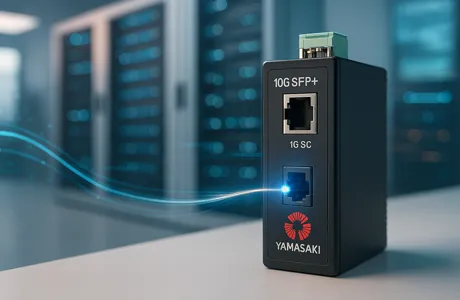
10G Media Converter – High-Speed Networking Simplified
Introduction – The Rise of the 10G Media Converter
As modern networks demand faster speeds, lower latency, and more efficient infrastructure, organisations are increasingly turning to the 10G Media Converter to meet those expectations. From cloud computing and large-scale data centres to AI-driven analytics and high-definition video transmission, 10 Gigabit performance has quickly become a requirement—not a luxury.
Many businesses still rely on 1G or legacy copper-based connections, which are no longer sufficient for today’s bandwidth-heavy workloads. Fortunately, the 10G Media Converter offers a simple, cost-effective way to bridge high-speed fibre links with existing Ethernet networks.
These converters deliver 10 Gigabit data rates over fibre, using SFP+ slots or SC/LC connectors, and support both multimode and single-mode fibre types. As a result, they make it easier than ever to scale bandwidth without replacing entire infrastructures.
Furthermore, with plug-and-play deployment, compact form factors, and support for advanced features like PoE passthrough and remote management (in managed models), 10G converters are suitable for both small and large-scale deployments.
To understand how these devices fit into your broader network strategy, explore our comprehensive overview here:
Media Converters – Bridging Network Gaps
What Is a 10G Media Converter?
A 10G Media Converter is a high-speed networking device that converts 10 Gigabit fibre optic signals into electrical Ethernet signals—and vice versa. It enables the connection between fibre and copper networks without sacrificing performance.
These converters are essential for linking modern 10G fibre backbones to existing infrastructure. They provide a cost-effective way to upgrade networks without replacing switches, routers, or cabling.
Key Features of a 10G Media Converter:
- Supports 10Gbps transmission speeds
- Compatible with SFP+ transceivers or SC/LC fibre connectors
- Works with single-mode and multimode fibre
- Enables long-distance data transfer (up to 80 km with single-mode)
- Reduces latency and packet loss in high-performance environments
- Offers plug-and-play setup for fast deployment
Because of these capabilities, 10G media converters are ideal for data centres, server rooms, and enterprise core networks.
To understand how fibre converters function in general, visit:
How Do Fibre Media Converters Work?
Key Benefits of 10G Media Converters
Upgrading to 10 Gigabit infrastructure doesn’t have to involve complex or costly network overhauls. With a 10G Media Converter, you can quickly expand fibre capabilities while preserving your current hardware investment.
Here’s why these devices are gaining popularity across industries:
1. Future-Proof Your Network
As data consumption continues to rise, so does the need for faster, more scalable connections. A 10G media converter allows you to transition from 1G to 10G speeds without replacing legacy switches or copper cabling.
Furthermore, you can gradually upgrade your network as bandwidth demands grow—making the investment both flexible and scalable.
2. Extend Fibre Uplinks Over Long Distances
Unlike copper Ethernet, which is limited to 100 metres, fibre can transmit over tens of kilometres with the right transceiver. A 10G converter makes it easy to push your backbone across campuses, remote buildings, or cross-floor deployments.
In addition, these converters support both single-mode and multimode fibre, offering even more flexibility in design.
3. Improve Performance With Low Latency
High-speed applications like video streaming, virtualisation, and cloud computing demand ultra-low latency. With 10G converters, you reduce jitter, prevent congestion, and improve throughput—especially in data centre interconnects or edge computing deployments.
4. Simplify Network Expansion
Because most 10G converters are plug-and-play, you can deploy them without advanced configuration. This ease of setup saves time for IT teams and avoids unnecessary service interruptions.
For example, you can link a 10G fibre switch to a copper server or NAS in just minutes—no firmware updates or complex routing required.
5. Reduce Costs Through Selective Upgrades
Rather than replacing all network hardware at once, 10G media converters allow you to upgrade selectively. This approach reduces both capital expenses and deployment risk.
If you’re unsure whether fibre is necessary for your application, see:
Copper to Fibre Media Converter – When and Why You Need One
1G vs 10G Media Converters
Choosing the right converter depends on your network speed requirements and future plans. While both 1G and 10G media converters serve similar functions, they differ significantly in performance, scalability, and use case.
Below is a direct comparison to help you decide when to upgrade to a 10G Media Converter.
Comparison Table
| Feature | 1G Media Converter | 10G Media Converter |
|---|---|---|
| Speed | Up to 1 Gbps | Up to 10 Gbps |
| Use Cases | Offices, small networks | Data centres, high-performance enterprise setups |
| Ports | RJ-45 / SC connectors | SFP+, LC, SC connectors |
| Fibre Distance | 550m (multimode), up to 2km (single-mode) | Up to 10–80 km (single-mode) |
| Latency | Moderate | Low latency, high throughput |
| Future-Proofing | Limited upgrade path | Highly scalable and compatible |
Why Upgrade to 10G Now?
Although 1G solutions still serve basic networking needs, they quickly become bottlenecks in cloud environments, multi-user offices, or media-heavy workflows.
By contrast, 10G converters enable you to handle higher data volumes with less congestion. Furthermore, as more organisations transition to hybrid or cloud-native systems, upgrading to 10G offers a competitive advantage.
If you’re working on backbone upgrades or linking high-speed endpoints, 10G media converters provide the best balance between performance and investment.
To explore how form factor influences choice, check out:
Standalone vs Chassis Media Converters – Which Is Right for You?
How to Install a 10G Media Converter
Installing a 10G Media Converter is typically straightforward, especially when you follow best practices. These devices are built for plug-and-play operation, making them ideal for rapid upgrades or edge expansion.
Here’s how to get started with installation:
Step-by-Step Installation Guide
- Confirm Compatibility
Before installation, make sure your network devices support 10G speeds. Additionally, verify whether you’re using single-mode or multimode fibre, and choose the appropriate SFP+ module accordingly. - Insert the SFP+ Transceiver
Gently insert the 10G SFP+ transceiver into the converter’s SFP+ slot. Ensure it clicks into place. This module enables the fibre interface and determines the converter’s range and compatibility. - Connect the Fibre Cable
Next, plug in your fibre cable (LC, SC, or compatible with the transceiver type). Be sure to use clean connectors and match transmit and receive pairs correctly. - Attach the Ethernet Connection
Connect a Cat6a or Cat7 Ethernet cable to the RJ-45 or 10GBASE-T port. This step links your converter to the copper-based network device, such as a server, switch, or NAS. - Apply Power and Monitor LEDs
Plug in the power supply. Once powered, check the LED indicators for link status, transmission speed, and power confirmation. These lights help verify proper operation before live deployment. - Perform Speed and Signal Testing
Use built-in diagnostics (on managed models) or third-party tools to test latency, packet loss, and bandwidth flow. This ensures your link is fully operational before pushing production traffic.
For more on managed features and remote configuration options, refer to:
Managed vs Unmanaged Media Converters – What’s the Difference?
Real-World Applications for 10G Converters
A 10G Media Converter supports much more than just fast data transmission. It plays a vital role in modernising fibre infrastructure while keeping legacy equipment relevant. Because of its versatility and high performance, organisations across many sectors now rely on 10G converters in day-to-day operations.
Below are common real-world use cases that highlight the value of these converters:
Data Centres and Server Rooms
Data centres demand high-speed connections with minimal latency. A 10G converter allows administrators to bridge copper-based switches with 10G fibre backbones quickly. Furthermore, it simplifies hardware upgrades by enabling fibre access without replacing all network switches at once.
Enterprise Network Backbones
As enterprises shift toward cloud-hosted applications and virtualised environments, internal network speeds must keep pace. 10G converters make it easier to connect departments, floors, or satellite buildings via fibre—ensuring consistent bandwidth delivery across the organisation.
High-Speed NAS and Storage Access
File sharing and data backups often cause bottlenecks over slower links. However, with a 10G Media Converter, businesses can deploy high-speed NAS systems using fibre uplinks—even when their existing core switch only supports copper Ethernet.
Edge Computing and AI Workflows
Many AI applications generate large datasets at the edge. Transmitting this data quickly to central processing hubs is essential. 10G converters help link smart devices and edge sensors to your data core efficiently and with low latency.
Smart Campuses and IoT Deployments
On university campuses, large hospitals, and industrial facilities, 10G converters extend high-speed fibre across vast grounds. As a result, they enable everything from surveillance systems and interactive displays to IoT gateways and connected utilities.
Want to see how industrial-grade media converters operate in extreme conditions? Visit:
Industrial Media Converter – Built for Harsh Environments
Compliance & Product Highlight
Choosing a 10G Media Converter isn’t only about performance. It’s also about ensuring the device meets national safety standards and is engineered for long-term reliability. In regulated sectors—such as telecommunications, government, and healthcare—compliance is mandatory, not optional.
Australian Standards and Legal Requirements
To ensure legal deployment in Australia, fibre connectivity hardware must comply with the following:
- AS/CA S008:2020 – Cabling Product Requirements
This standard outlines the technical and safety specifications for equipment used in fixed installations. Converters used in structured cabling systems must meet these rules to avoid fines or failure during audits. - AS/NZS 3000 – Electrical Wiring Rules
Particularly relevant when 10G converters are installed near power systems or in electrical cabinets, this standard ensures safe electrical integration. - RCM Marking and EMC Compliance
Any device sold and installed in Australia must carry the Regulatory Compliance Mark (RCM), confirming it has passed electromagnetic compatibility (EMC) testing.
Furthermore, choosing compliant equipment reduces installation risk, supports government tender eligibility, and reinforces your network’s reliability from day one.
Trusted 10G Media Converter – Yamasaki YMS10GSFP-2SC
To meet these standards, we recommend the
Yamasaki YMS10GSFP-2SC 10G Media Converter
This model supports:
- 10G SFP+ ports
- Single-mode or multimode compatibility
- DIN rail or rack mounting
- Extended operating temperature
- AS/CA S008 and EMC compliance
- Plug-and-play fibre-to-copper bridging
In addition, it’s available directly from Anderson:
Anderson YMS10GSFP-2SC – 10G Media Converter
When reliability, compliance, and futureproof performance matter—this is the solution to trust.
Frequently Asked Questions About 10G Media Converters
1. What is the main advantage of using a 10G Media Converter?
A 10G Media Converter lets you bridge fibre and Ethernet networks while upgrading to 10 Gigabit speeds.**
Unlike legacy 1G converters, it handles high-bandwidth tasks such as video processing, server replication, and cloud transfers—without replacing your entire network. In addition, it reduces latency and extends fibre reach across longer distances.
2. Can I use a 10G Media Converter with existing multimode fibre?
Yes, most 10G converters are compatible with both multimode and single-mode fibre. However, you’ll need the correct SFP+ module based on your fibre type. For shorter distances, multimode works well. For cross-building or campus links, single-mode is a better option.
3. Is the converter plug-and-play or does it require configuration?
In most cases, 10G Media Converters are completely plug-and-play. You simply install the correct SFP+ module, connect your fibre and Ethernet cables, and apply power. That said, if you’re using a managed version, additional configuration (such as VLAN tagging or link fault pass-through) may be required.
4. Can I connect a 10G Media Converter directly to a switch or server?
Absolutely. In fact, many businesses use these converters to link 10G switches, high-performance servers, or NAS devices directly to fibre uplinks. Just ensure that the endpoint device has a compatible 10GBASE-T port or SFP+ interface, depending on your converter model.
5. Are 10G Media Converters suitable for industrial use?
Yes, but only if the unit is rated for industrial environments. For example, the
YMS10GSFP-2SC 10G Media Converter
offers extended temperature support, a metal housing, and EMC compliance. Therefore, it’s ideal for deployment in warehouses, smart grids, or transport infrastructure.
For even harsher environments, you may want to explore:
Industrial Media Converter – Built for Harsh Environments
Why a 10G Media Converter Is the Smart Choice
As bandwidth demands continue to grow, upgrading your network backbone is no longer optional—it’s essential. A 10G Media Converter offers a practical, cost-effective solution that bridges the gap between high-speed fibre and your existing Ethernet infrastructure.
Unlike full hardware overhauls, converters let you scale your network gradually. You can upgrade only the links that need it while keeping legacy switches and servers in place. This not only reduces capital costs but also minimises disruption.
Furthermore, with support for long-distance fibre transmission, ultra-low latency, and plug-and-play deployment, 10G converters offer the performance your network needs—without the complexity.
Whether you’re running a data centre, managing a multi-building campus, or connecting edge devices to a core switch, a 10G Media Converter gives you the flexibility to expand intelligently and securely.
Upgrade Your Network with Confidence
Don’t let outdated 1G infrastructure limit your business. A 10G Media Converter helps you move faster, operate smarter, and scale for the future—starting today.
Explore one of the most trusted solutions on the market:
YMS10GSFP-2SC 10G Media Converter by Anderson
Also available from the manufacturer:
Yamasaki YMS10GSFP-2SC Product Page
And if you’d like to understand where these converters fit into your broader network strategy, be sure to read:
Media Converters – Bridging Network Gaps
Now’s the time to bring your network up to speed—literally.